

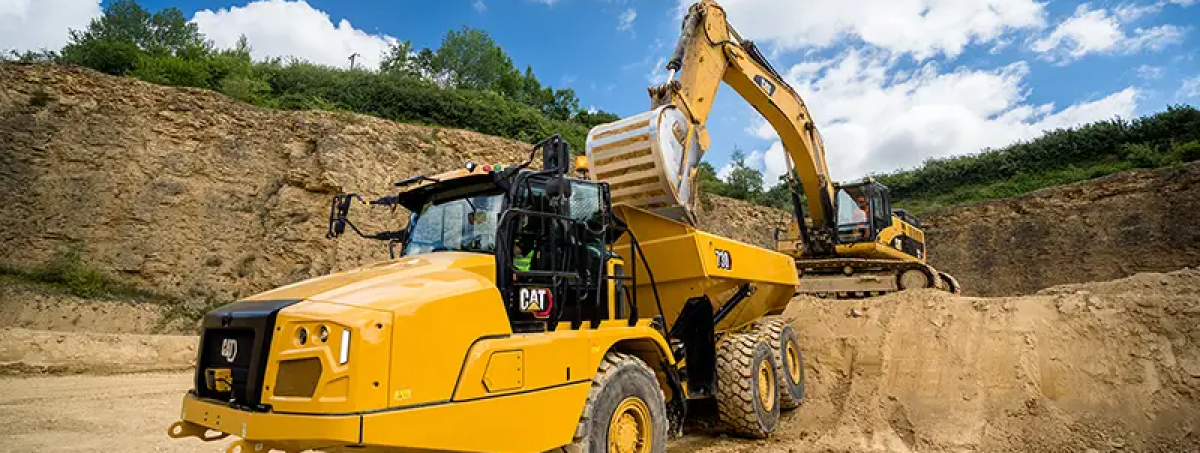
Miller Plant has invested £1.7m in seven new Cat machines from Finning UK & Ireland, a fleet upgrade that gives the Aberdeenshire earthworks contractor telematics-enabled equipment aimed at cutting fuel costs on civil and infrastructure projects across the north east.
Miller Plant, founded in 1968 and headquartered in Inverurie, Aberdeenshire, is a fourth-generation family-owned contractor delivering bulk earthworks, contract crushing, plant hire, haulage and aggregate supply across the north east of Scotland.
Finning UK & Ireland, part of Canada's Finning International, is the world's largest Caterpillar dealer, supplying equipment, parts and service across the UK and Ireland.
The purchase includes two Cat 730 articulated trucks, a Cat 966 XE medium wheel loader, a 340 excavator, a 330 excavator, and two vibratory soil compactors, fitted with technology including Object Detect with Stability Assist, 2D Grade Assist, E Fence virtual boundaries and VisionLink remote asset monitoring.
Managing director Ian Miller said the new machines would support major civil and infrastructure projects across the north east, highlighting the idle management system on the Cat 966 XE wheel loader as a way to reduce fuel costs for customers, while Finning's John Stuart said the added technology would help Miller Plant continue delivering high performance across its range of applications.
The total investment is valued at £1.7m (€1.99m); pricing for individual machines was not disclosed.
Buying telematics-equipped machines rather than standard models signals that fuel and uptime data, not just raw machine capacity, are now central to how earthworks contractors compete on cost.
Idle-time monitoring and driver behaviour tracking typically deliver 15 to 25% fuel savings on construction fleets, with some operators reporting payback on the technology investment within months rather than years.
Scotland's plant hire and contracting sector has been moving in the same direction, with low-emission fleets and connected machine data becoming a standard expectation on tenders rather than a differentiator reserved for the largest national contractors.
For the sector, equipment purchasing decisions are increasingly driven by fuel, safety and uptime data over a machine's working life rather than headline purchase price or raw capacity, and contractors that adopt this technology earlier gain a real cost advantage bidding for margin-thin civil and infrastructure work.
Source: Project Plant
















.png)